Abstract Data Charts: A Visual Guide to Data Analysis and Presentation
Abstract Data Charts are a powerful tool for visualizing complex data in a clear and engaging way. Whether you're dealing with financial trends, marketing performance, or statistical analysis, these charts can help you present information in a format that is both visually appealing and easy to understand.
Understanding Abstract Data Charts
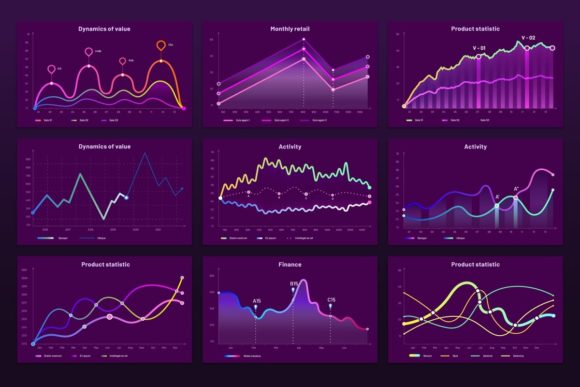
Abstract Data Charts encompass a wide range of graphical representations, including statistic graphs, finance line charts, and marketing histogram graphs. These charts are designed to provide a high-level overview of data, making it easier to identify patterns, trends, and outliers. The use of abstract elements, such as futuristic neon designs and holographic displays, adds a modern and dynamic touch to the presentation of data.
Challenges and Needs in Data Visualization
Data visualization often faces several challenges, such as:
- Data Complexity: Large datasets can be overwhelming, making it difficult to discern meaningful insights.
- Engagement: Traditional charts may not capture the audience's attention, leading to disinterest and poor retention.
- Customization: Different users have different needs, and finding a one-size-fits-all solution can be challenging.
Abstract Data Charts address these challenges by providing a visually rich and customizable platform for data presentation. They help in simplifying complex data, making it more accessible and engaging for the audience.
Practical Applications of Abstract Data Charts
Abstract Data Charts can be used in various fields, including finance, marketing, and research. Here are some practical applications:
- Financial Analysis: Finance line charts can help in tracking stock prices, market trends, and investment performance over time. The use of abstract elements like neon colors and holographic displays can make the data more visually appealing and easier to interpret.
- Marketing Performance: Marketing histogram graphs can be used to analyze the distribution of customer engagement, sales, and other key metrics. This helps in identifying areas of strength and weakness, allowing for more targeted and effective marketing strategies.
- Statistical Research: Statistic graphs can be used to present research findings in a clear and concise manner. Abstract Data Charts can help in highlighting significant trends and patterns, making the data more impactful and memorable.
Examples and Recommendations
Here are some examples and recommendations for using Abstract Data Charts effectively:
- Use Consistent Color Schemes: Choose a color palette that is consistent and visually appealing. This helps in maintaining a professional and cohesive look across all charts.
- Incorporate Interactive Elements: Adding interactive features, such as tooltips and clickable segments, can enhance user engagement and provide more detailed information on demand.
- Focus on Key Metrics: Highlight the most important data points and metrics to ensure that the audience can quickly grasp the key insights.
For instance, a financial analyst might use a finance line chart with a holographic display to track the performance of a portfolio over time. By incorporating interactive elements, the analyst can provide additional context and details when needed, making the chart more informative and user-friendly.
Different Approaches for Different Users
Users from different backgrounds and with different needs may approach Abstract Data Charts in various ways:
- Business Executives: They may prefer high-level overviews and summary charts that highlight key trends and performance metrics. Abstract Data Charts with futuristic neon designs can help in presenting this information in a visually striking and professional manner.
- Data Analysts: They might require more detailed and customizable charts that allow for in-depth analysis. The ability to separate elements and edit specific parts of the chart using vector editors like Adobe Illustrator can be particularly useful for them.
- Academics and Researchers: They may need charts that are both visually appealing and scientifically accurate. Abstract Data Charts with clear and precise labeling, along with the option to include additional data layers, can be very beneficial for their work.
Conclusion
Abstract Data Charts offer a versatile and visually engaging way to present and analyze data. By addressing the challenges of data complexity, engagement, and customization, these charts can help users in various fields to better understand and communicate their data. Whether you are a business executive, a data analyst, or an academic, Abstract Data Charts can be a valuable tool in your data visualization toolkit.
For those looking to use Abstract Data Charts, the product file includes one JPEG at 72ppi and one EPS10. If you need to separate elements, remove, or edit something, using a vector editor like Adobe Illustrator is recommended. With the right tools and approach, Abstract Data Charts can transform the way you present and interact with data.